Relationship of Physicochemical Water Parameters and Sediment Characteristics to the Growth of Eucheuma cottonii Cultivated Using the Longline Method on Karampuang Island, West Sulawesi
Abstract
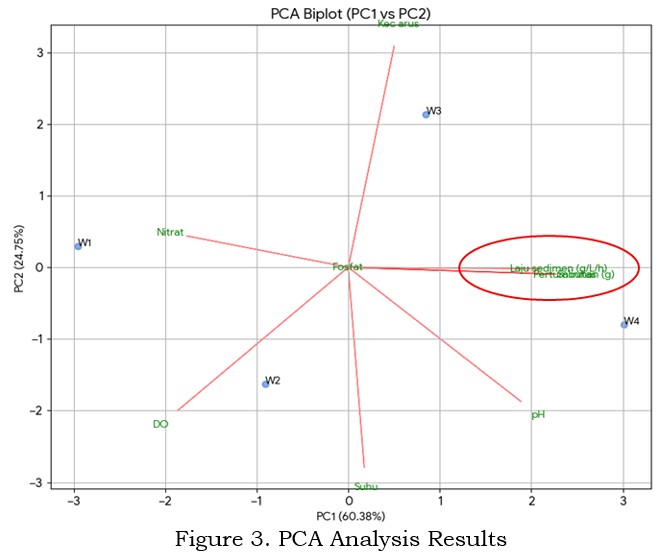
Seaweed is an economically valuable commodity with the potential to improve the welfare of coastal communities, including Eucheuma cottonii. However, E. cottonii cultivation faces challenges from extreme changes in aquatic conditions and sediment input from river estuaries, which may inhibit its growth. This study aimed to analyze the relationship between physicochemical water parameters and sediment characteristics and the growth of E. cottonii cultivated using the longline method on Karampuang Island, West Sulawesi. A quantitative approach was applied through a field experiment using a completely randomized design (CRD) on three longline stretches over 30 days. Water quality and sediment parameters were analyzed descriptively, while relationships among variables were tested using partial correlation analysis. The results showed that most physicochemical water parameters were within the optimal range, except for current velocity, which was relatively low at 0.11 m/s. Sediment at the study site was dominated by medium sand, with a dynamic daily sedimentation rate ranging from 0.08 to 0.43 g/L/hour. The absolute growth of E. cottonii reached 477.00 g, with an average daily growth rate of 16.66 g/day. Partial correlation analysis showed that the growth of E. cottonii was closely associated with sedimentation rate and salinity. The cultivation of E. cottonii using the longline method on Karampuang Island showed positive growth, supported by suitable physicochemical water conditions, although sedimentation remained dynamic.
References
Afandi, A., Budiyanti, Rilamaya, W. O., Safia, W. O., Sukendar, W., & Hasrah. (2026). Water quality of seaweed growth (Eucheuma cottonii) in Sampolawa Bay, South Buton Regency. Akuatikisle: Jurnal Akuakultur, Pesisir dan Pulau-Pulau Kecil, 10(1), 43–50. https://doi.org/10.29239/j.akuatikisle.10.1.43-50
Alamsyah, R. (2016). Kesesuaian Parameter Kualitas Air untuk Budidaya Rumput Laut di Desa Panaikang Kabupaten Sinjai. Agrominansia, 1(1), 61–71. https://doi.org/10.34003/271882
Atmanisa, A., Mustarin, A., & Anny, N. (2020). Analisis Kualitas Air pada Kawasan Budidaya Rumput Laut Eucheuma Cottoni di Kabupaten Jeneponto. Jurnal Pendidikan Teknologi Pertanian, 6(1), 11–22. https://doi.org/10.26858/jptp.v6i1.11275
Badan Standar Nasional. (2011). SNI 7673.2:2011: Produksi Bibit Rumput Laut Kotoni (Eucheuma cottonii) Metode Longline. Jakarta: Badan Standardisasi Nasional.
Cokrowati, N., Risjani, Y., Firdaus, M., & Andayani, S. (2021). Accelerated growth of Kappaphycus alvarezii using Sargassum aquifolium extract and its anatomical characteristics. Biodiversitas: Journal of Biological Diversity, 22(11), 5195–5202. https://doi.org/10.13057/biodiv/d221158
Darmawati, Sutinah, Ode, I., Setyono, B. D. H., Laheng, S., Mujtahidah, T., Sari, Y. P., Putri, I. W., Abidin, Z., Sukendar, W., Sulthoniyah, S. T. M., Marda, A. B., Yusuf, M. A., Suci, A. N. N., Abdullah, A., & Setyaka, V. (2023). Kiat Agribisnis Rumput Laut. CV. Tohar Media.
Devi, F. P., Riyadi, D. N., Kurniawansyah, F., & Roesyadi, A. (2020). Produksi Kappa Karaginan dari Rumput Laut (Eucheuma cottonii) dengan Metode Semi-Refined Carrageenan. Journal of Fundamental and Applications of Chemical Engineering, 1(1), 1–4. https://doi.org/http://dx.doi.org/10.12962%2Fj2964710X.v1i1.12724
Halimah, N., Usman, H., & Kasnir, M. (2021). Laju Pertumbuhan dan Produksi Rumput Laut (Kappaphycus alvarezii) dengan Metode Budidaya Yang Berbeda di Pesisir Pantai Kecamatan Mare Kabupaten Bone. Seminar Ilmiah Nasional Fakultas Perikanan Dan Ilmu Kelautan Universitas Muslim Indonesia,1, 61–75.
Hasan, M. R., Rejeki, S., & Ariyati, R. W. (2015). Pengaruh Bobot Awal yang Berbeda terhadap Pertumbuhan Gracilaria sp. yang dibudidayakan dengan Metode Longline di Perairan Tambak Terabrasi Desa Kaliwlingi Kabupaten Brebes. Journal of Aquaculture Management and Technology, 4(1), 92–99.
Hernanti, A. D., Rejeki, S., & Ariyati, R. W. (2015). Pertumbuhan Budidaya Rumput Laut (Eucheuma cottoni dan Gracilaria Sp.) dengan Metode Longline di Perairan Pantai Bulu Jepar. Journal of Aquaculture Management and Technology, 4(2), 60–66.
Kramandondo, R. A., Hadijah, H., & Mulyani, S. (2022). Pengaruh Ekologi dan Habitat terhadap Pertumbuhan Rumput Laut (Eucheuma cotonii) di Teluk Bicari Kabupaten Kaimana. Journal of Aquaculture and Environment, 4(2), 50–55. https://doi.org/10.35965/jae.v4i2.1456
Mansur, L. K., Kasim, M., & Palupi, R. D. (2023). Karakteristik Pola Arus dan Nutrien Perairan pada Areal Budi Daya Rumput Laut di Pantai Bone-Bone Kota Baubau. Jurnal Kelautan: Indonesian Journal of Marine Science and Technology, 16(2), 125–138. https://doi.org/10.21107/jk.v16i2.17479
Maulana, F. W., Minsas. S., & Safitri, I. (2023). Laju Pertumbuhan Rumput Laut Eucheuma cottonii Berdasarkan Perbedaan Kedalaman dengan Metode Keramba Jaring Apung di Perairan Pulau Lemukutan. Jurnal Laut Khatulistiwa, 6(2), 58–70. https://doi.org/10.26418/lkuntan.v6i2.58126
Nikhlani, A., & Kusumaningrum, I. (2021). Analisa Parameter Fisika dan Kimia Perairan Tihik Tihik Kota Bontang untuk Budidaya Rumput Laut Kapphaphycus alvarezii. Jurnal Pertanian Terpadu, 9(2), 189–200. https://doi.org/10.36084/jpt..v9i2.328
Noor, R. J. (2018). Characteristics and Sediment Distribution of Coastal Mamuju District. Marina Chimica Acta, 19(1), 20–27.
Noor, R. J., Lanuru, M., & Faizal, A. (2020). TSS Assimilation Capacity in The Mamuju River Estuary. JFMR (Journal of Fisheries and Marine Research), 4(3), 324–331. https://doi.org/10.21776/ub.jfmr.2020.004.03.2
Nurqomar, A., Idiawati, N., & Minsas, S. (2022). Laju Pertumbuhan Eucheuma cottonii dengan Metode Long Line Berbingkai di Perairan Pulau Lemukutan. Oseanologia, 1(3), 78–83. https://doi.org/10.21776/ub.jfmr.2020.004.03.2
Oktaviani, A., Yusuf, M., & Maslukah, L. (2015). Sebaran Konsentrasi Nitrat dan Fosfat di Perairan Muara Sungai Banjir Kanal Barat, Semarang. Journal of Oceanography, 4(1), 85–92.
Pastorok, R. A., & Bilyard, G. R. (1985). Effects of sewage pollution on coral-reef communities. Marine Ecology Progress Series, 21(1/2), 175–189. http://www.jstor.org/stable/24816929
Patahiruddin, P. (2020). Pengaruh Nitrat Substrat Terhadap Pertumbuhan Rumput Laut Gracilaria verrucosa Di Tambak Budidaya Desa Lare-Lare Kabupaten Luwu Sulawesi Selatan. Fisheries of Wallacea Journal, 1(1), 1–8. https://doi.org/10.55113/fwj.v1i1.314
Putra, A. E., Najamuddin, N., & Hajar, M. A. I. (2013). Pengaruh Arah dan Kecepatan Arus terhadap Hasil Tangkapan Jaring Perangkap Pasif (Set Net) di Teluk Mallasoro, Jeneponto. Jurnal Sains & Teknologi, 13(3), 257–263.
Susanto, A. B., Siregar, R., Hanisah, H., Faisal, T. M., & Harahap, A. (2021). Analisis Kesesuaian Kualitas Perairan Lahan Tambak Untuk Budidaya Rumput Laut Gracilaria sp. di Kecamatan Langsa Barat, Kota Langsa. JFMR (Journal of Fisheries and Marine Research), 5(3), 655–667. https://doi.org/10.21776/ub.jfmr.2021.005.03.18
Wahab, G. G. S., & Agusdiansyah, D. (2023). Sebaran Sedimen di Dego-Dego, Sulawesi Selatan. Riset Sains dan Teknologi Kelautan, 6(1), 79–85. https://doi.org/10.62012/sensistek.v6i1.24260
Widyaningsih, S. D., Abida, I. W., Pramithasari, F. A., & Afifa, F. H. (2022). Kajian Kandungan Logam Berat kadmium Pada Air, Sedimen, dan Ikan Bawal (Pampus argenteus) di Tempat Pelelangan Ikan Branta Kabupaten Pamekasan. Juvenil:Jurnal Ilmiah Kelautan Dan Perikanan, 3(4), 100–109. https://doi.org/10.21107/juvenil.v3i4.17564
Zakariah, M. I., Koto, S., Irsan, I., & Fesanrey, W. (2023). Analisis Kualitas Perairan Budidaya Rumput Laut di Dusun Saliong Desa Batu Boy sebagai Dampak Gagal Panen. J Biol Pendidik dan Terap, 10(1), 91–101.
Copyright (c) 2026 Chairul Mahfud, Rahmat Januar Noor, Muhammad Aswad, Muh Ansar, Irma Yulia Madjid

This work is licensed under a Creative Commons Attribution-ShareAlike 4.0 International License.
Copyright on articles was retained by the respective author(s) without restrictions. The author grants the journal its first publication rights with the work simultaneously licensed under the Creative Commons Attribution-ShareAlike 4.0 International (CC BY-SA) license. This means anyone is free to copy, transform, or redistribute articles for any lawful purpose in any medium, provided they give appropriate attribution to the original author(s).